
Most social media managers spend about 70% of their week fighting the same battle: the blank cursor. Whether it's a LinkedIn thought-piece or a snappy Instagram caption, the friction of starting from scratch kills creativity. But we've hit a tipping point. ChatGPT is a large language model developed by OpenAI that uses generative artificial intelligence to create human-like text, code, and analysis. It isn't just a tool for writing faster; it's a fundamental shift in how brands communicate. If you're still using it just to 'write a post,' you're missing the actual revolution.
Quick Wins for Your SMM Workflow
- Instant Ideation: Turn one long-form blog post into 15 distinct social snippets across different platforms.
- Persona Mapping: Create detailed customer avatars and ask the AI to critique your copy from their perspective.
- Sentiment Analysis: Paste 100 customer comments and get a bulleted list of the top three pain points.
- Ad Variation: Generate 10 different hooks for a single Meta ad to find the winning angle through A/B testing.
Moving Beyond the Prompt
The biggest mistake people make with social media marketing is treating the AI like a vending machine-you put in a prompt, and you expect a perfect post. That's why so much AI content feels robotic and soulless. The real power lies in the iterative loop. Instead of saying "Write a post about my new shoes," try "Act as a high-end fashion critic who hates minimalism. Critique these shoes and tell me why a Gen Z buyer in London would actually care about them."
By assigning a specific role, you force the model to move away from generic patterns. This is where Prompt Engineering comes in. It's the art of providing context, constraints, and examples. When you give the AI a few examples of your brand's actual voice-say, a mix of sarcasm and deep technical knowledge-it stops sounding like a brochure and starts sounding like your best copywriter.
Automating the Content Lifecycle
In 2026, the goal isn't just to create content, but to manage a massive volume of assets without losing quality. This is where Generative AI integrates with your broader stack. Imagine a workflow where your Content Calendar is automatically populated based on trending topics identified by the AI, and the first drafts are waiting for you every Monday morning.
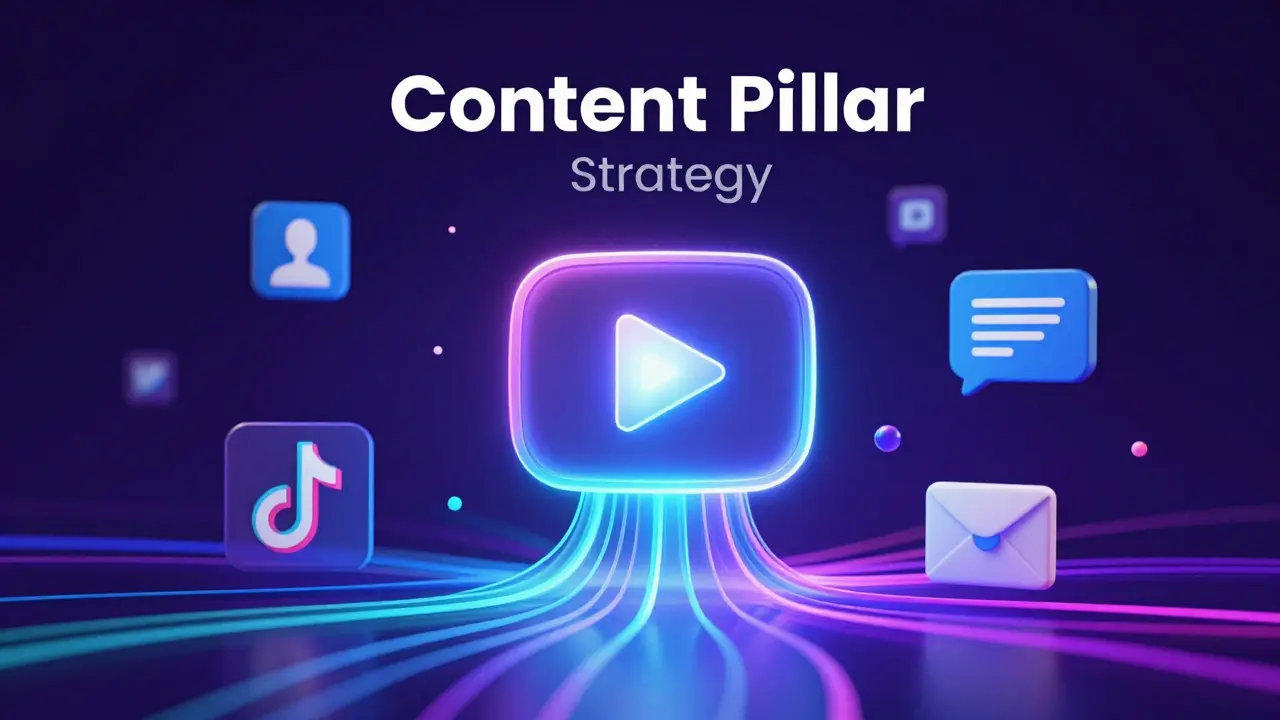
Consider the "Content Pillar" strategy. You start with one deep-dive video on YouTube. You feed the transcript into ChatGPT and ask it to extract:
- A provocative X (formerly Twitter) thread that sparks debate.
- A professional summary for LinkedIn targeting C-suite executives.
- Three short, punchy scripts for TikToks focusing on the most surprising facts from the video.
- An email newsletter teaser that drives traffic back to the original video.
This isn't just efficiency; it's about maximizing the ROI of a single piece of intellectual property.
| Feature | Traditional SMM | AI-Driven SMM |
|---|---|---|
| Ideation | Manual brainstorming sessions | Rapid AI clustering and trend analysis |
| Content Creation | Writing each post from scratch | Iterative refining of AI-generated drafts |
| Audience Research | Surveys and manual observation | AI-powered sentiment and pattern mapping |
| A/B Testing | Testing 2-3 versions per ad | Testing dozens of AI-generated hooks |
The New Guard of Community Management
Community management is often the most draining part of the job. Dealing with the same five questions every day is a recipe for burnout. However, the integration of Conversational AI has changed the game. While we aren't at the point where you can totally ignore your followers, you can use AI to draft responses that maintain your brand's tone while providing instant, accurate information.
For example, if a customer asks about a shipping delay on a public post, you can use a custom-trained AI agent that has access to your Customer Relationship Management (CRM) data. It can draft a response that acknowledges the specific order number and offers a discount code, which you then review and hit "send" on. You've just turned a potential PR disaster into a loyalty-building moment in thirty seconds.
Avoiding the 'AI Uncanny Valley'
There is a danger here. When everything is optimized by an algorithm, everything starts to look the same. We're seeing a rise in "AI fatigue," where users can smell a GPT-generated caption from a mile away. To avoid this, you need to apply the 80/20 rule: let AI do 80% of the heavy lifting (research, structuring, first drafts) and spend your human energy on the final 20%-the storytelling, the emotional nuance, and the fact-checking.
Real-world expertise is the only thing AI cannot fake. If you're selling a SaaS product for accountants, the AI can write a great list of benefits, but it can't describe the specific feeling of a deadline-induced panic during tax season. That's where you step in. Inject personal anecdotes and specific, messy human experiences into the AI's polished structure.
Strategic Scaling with AI Agents
We are moving toward a world of AI Agents-autonomous programs that don't just write, but act. In the context of SMM, this means agents that can monitor Social Listening tools in real-time. When a keyword related to your brand spikes on Reddit or TikTok, the agent can notify you and provide three potential response angles based on your brand guidelines.
This shifts the role of the Social Media Manager from a "creator" to an "editor-in-chief." You are no longer the one grinding out the posts; you are the one directing the strategy and ensuring the brand's soul remains intact. This allows small teams to operate with the output of a full-scale agency without the overhead.
Will ChatGPT replace social media managers entirely?
No, but managers who use AI will replace those who don't. AI lacks genuine emotional intelligence, the ability to form real human relationships, and the capacity for truly original strategic pivots. It handles the execution, but humans still provide the vision and empathy.
How do I stop my AI content from sounding generic?
The secret is in the constraints. Avoid vague prompts. Give the AI a specific persona, a set of "forbidden words" (like 'unlock,' 'game-changer,' or 'delve'), and a few examples of your best-performing historical posts to guide its style.
Is it risky to use AI for community management?
It can be if you automate it 100%. AI can occasionally "hallucinate" or misinterpret sarcasm. The safest approach is a "human-in-the-loop" system where AI drafts the response and a human approves it before it goes live.
What is the best way to use AI for hashtag research?
Instead of asking for a list of hashtags, provide the AI with your target audience's interests and ask it to categorize hashtags into 'broad,' 'niche,' and 'branded' buckets. This ensures a better balance for the platform's algorithm.
Can ChatGPT help with paid ad strategy?
Absolutely. It is excellent for brainstorming multiple hooks for the same offer. You can ask it to write ads using different psychological triggers-like scarcity, social proof, or loss aversion-and then test those versions against each other in Meta Ads Manager.
Next Steps for Implementation
If you're feeling overwhelmed, don't try to automate everything at once. Start by picking one painful part of your day-maybe it's the weekly reporting or the caption writing-and build a dedicated prompt library for it. Once you find a prompt that works, save it in a shared document for your team.
For those who want to scale, look into integrating your AI tools via API into your project management software. The goal is to reduce the distance between an idea and a published post. The faster you can test, the faster you can find what actually resonates with your audience in this fast-moving digital landscape.